Heydar Aliyev Center (Baku)
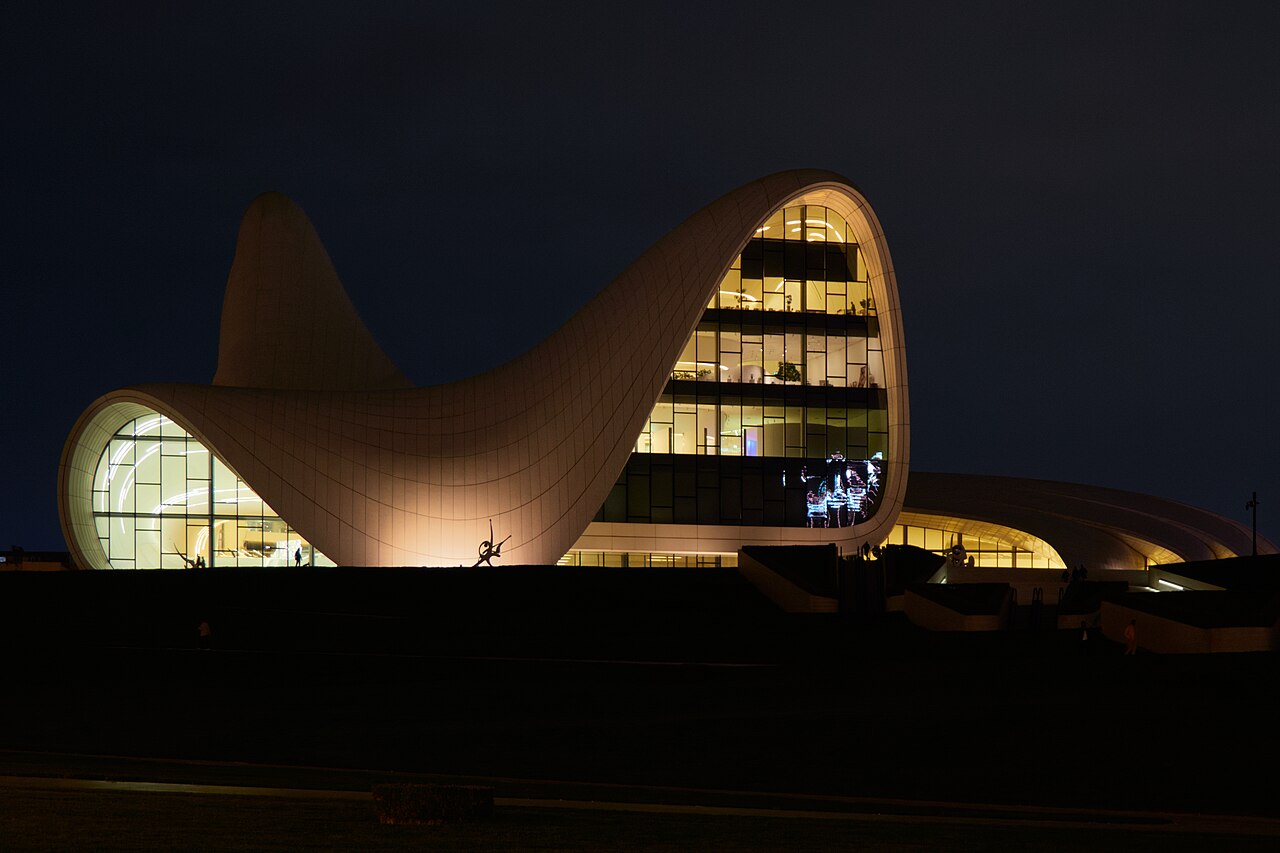
Zaha Hadid’s flowing white cultural centre with no straight lines, Baku’s best-known modern building.
About
The Heydar Aliyev Center seems to pour out of its plaza in one smooth wave, its white surface rising, folding and dipping with no sharp corners. The curves hide a large structure of concrete and steel, clad in glass-fibre-reinforced panels, which let the building look seamless in every direction.
Inside are a museum, exhibition halls and an auditorium, with a spiral foyer and sweeping stairs that echo the exterior. Even if you do not go in, the building is worth walking around, and at dusk it is lit up in changing colours.
History
The centre was designed by the architect Zaha Hadid and her studio, with Patrik Schumacher, and was opened in 2012. It is named after Heydar Aliyev, who led Azerbaijan in the Soviet era and again as president in the 1990s and early 2000s. Hadid’s aim was to break with the rigid, monumental style of Soviet buildings that had long dominated the city, and to express a more open and optimistic national image. The building was built on the site of a former Soviet-era complex, and its construction was a major engineering challenge because of the unusual curved geometry. In 2014 it won the Design Museum’s Design of the Year award in London, becoming one of the most celebrated buildings of its decade. The centre has since hosted exhibitions of art, history and design, as well as concerts and conferences.