Palace of the Shaki Khans (Shaki)
An eighteenth-century summer palace famous for vivid frescoes and shebeke stained-glass windows made without nails or glue.
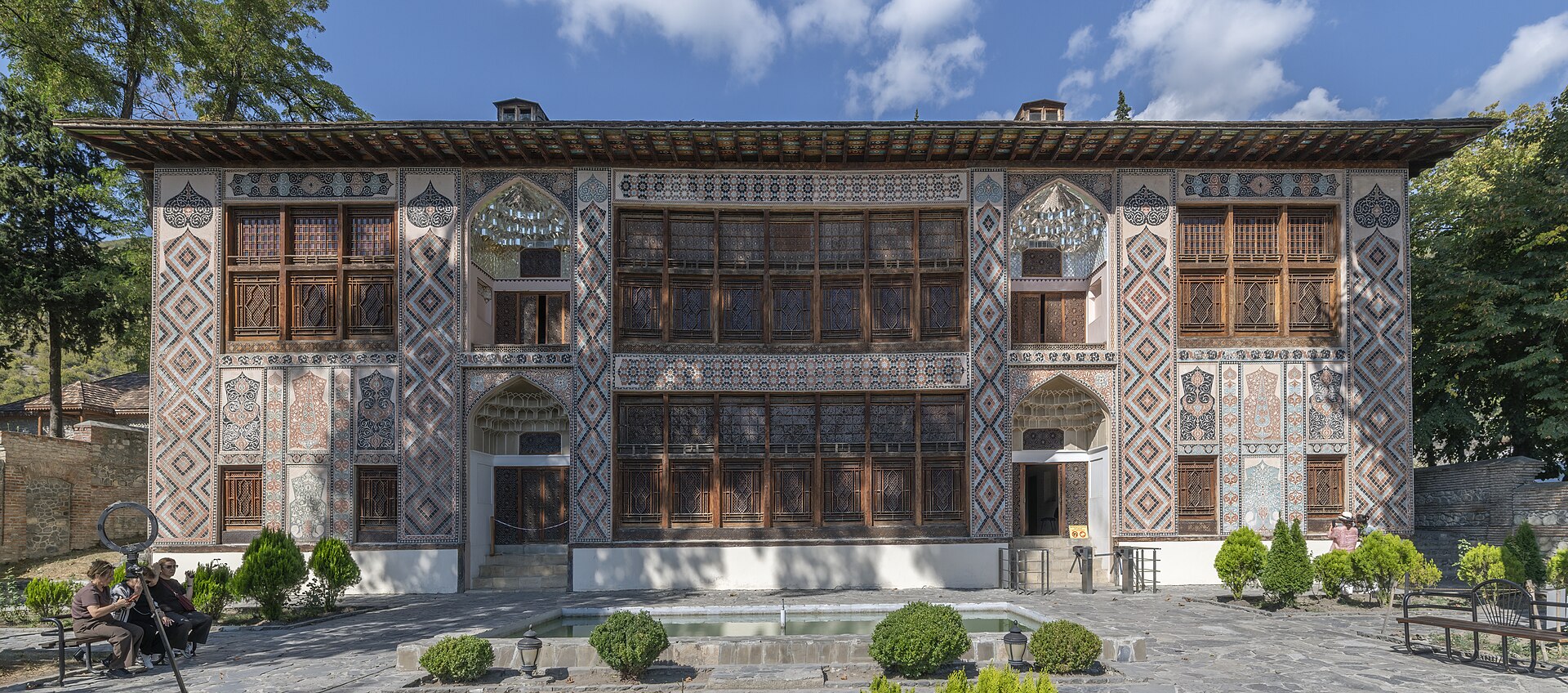
About
The palace is a small two-storey building in the old part of Shaki, standing in a garden beneath plane trees. From outside, its walls of thin brick and carved wood look simple, but inside every wall and ceiling is covered in colourful decoration.
The frescoes show flowers, hunting scenes and patterns in rich reds, blues and greens. The windows, called shebeke, are made of thousands of tiny pieces of coloured glass held in a wooden lattice, and sunlight through them casts moving colour across the rooms. The palace has just six rooms but is one of the best-loved sights in the country.
History
The palace was built in 1797 under Muhammad Hasan Khan, a ruler of the Shaki Khanate, which controlled the northern part of what is now Azerbaijan. It was meant as a summer residence for the khans, set within the grounds of a fortress. The builders used wood, river stones and limestone, and the entire structure was held together by a method that avoided nails, using only wooden pegs and lattices. The khanate was absorbed into the Russian Empire in the early nineteenth century, and the palace later served other roles but was kept and restored several times. Shaki was a centre of silk production and trade on the Silk Road, and the town still has a caravanserai that was used by merchants. The Historic Centre of Sheki with the Khan’s Palace was inscribed by UNESCO in 2019.
UNESCO World Heritage: Inscribed 2019.