Rila Monastery
Bulgaria’s most famous monastery, founded in the tenth century in the Rila Mountains and known for its striped arches and vivid frescoes. UNESCO-listed.
About
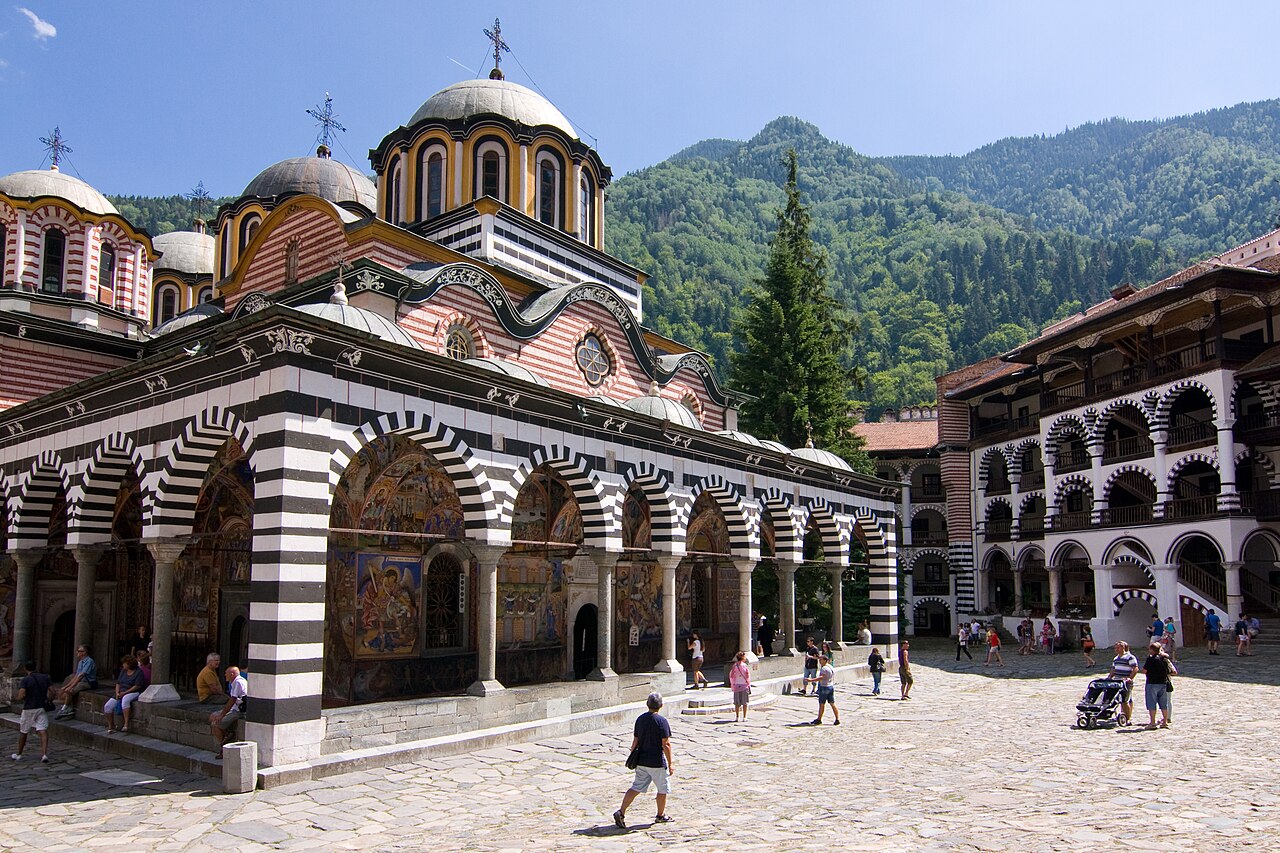
The monastery stands in a forested mountain valley, a fortress-like complex around a courtyard with a church at its centre. Its balconies and arcades are painted in bands of black, white and red, and the dark-stone walls rise several storeys.
Inside the church, every wall and ceiling is covered in frescoes, and an ornate carved altar screen glows with gold. A museum shows treasures including Raphael’s Cross, a tiny wooden cross carved with over a thousand figures. Many visitors stay overnight to see the courtyard in quiet.
History
The monastery was founded in the tenth century by followers of Saint Ivan of Rila, a hermit who lived in the mountains and became the country’s patron saint. In the Middle Ages, rulers of the Bulgarian Empire gave it land and privileges, and the surviving Hrelyo’s Tower, from the 1330s, is its oldest building. During the centuries of Ottoman rule, Rila kept alive Bulgarian language, writing and faith, and is often called a guardian of national identity. A great fire in 1833 destroyed most of the old buildings, and the monastery was rebuilt in the following years, with the main church finished in 1837. Leading artists of the Bulgarian National Revival, among them the Zograf brothers, painted its frescoes. The monastery was inscribed by UNESCO in 1983 and still has a community of monks.
UNESCO World Heritage: Inscribed 1983.