Thracian Tomb of Kazanlak
A fourth-century BC tomb with remarkable murals, in the Valley of the Roses.
About
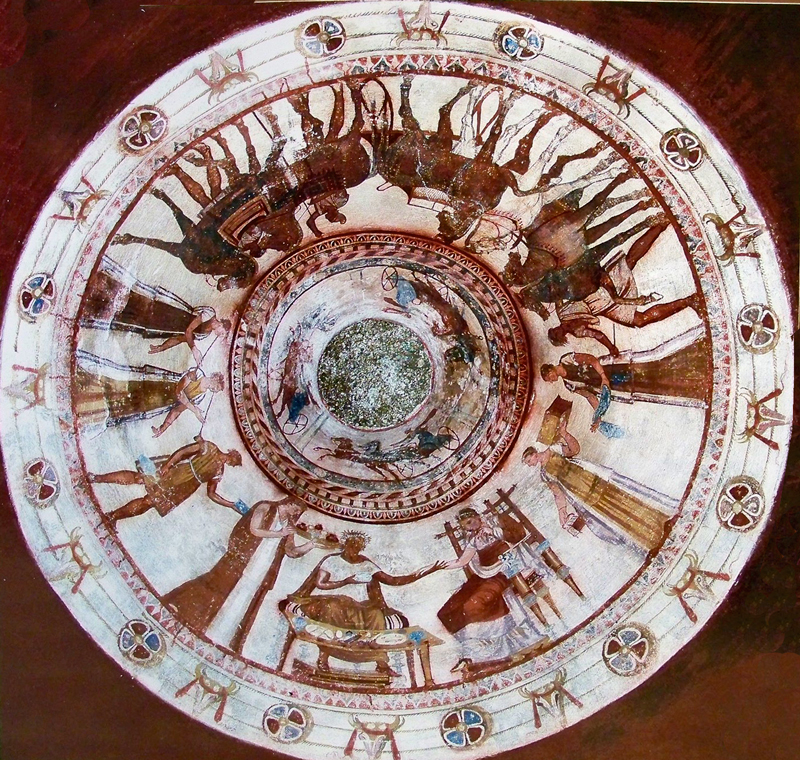
The tomb is a small beehive-shaped chamber built of brick under an earth mound, reached by a short corridor. Its dome is covered in paintings from the late fourth or early third century BC, still bright in reds, ochres and blues.
The murals show a seated Thracian couple, probably a ruler and his wife, being honoured by attendants with gifts, as well as horses and chariots. To protect the fragile paintings, the original tomb is closed, and visitors see a very faithful replica next to it.
History
The Thracians were a group of peoples who lived across much of the Balkans in antiquity, known as horsemen and warriors, and for rich burials. The Kazanlak tomb is thought to date from the late fourth or early third century BC and probably belonged to a local ruler of the time. It stood in a necropolis near the Thracian capital Seuthopolis, which was later submerged by a reservoir, and the burial mound hid it for over two thousand years. It was discovered in 1944 by soldiers digging a trench for an anti-aircraft position. After its discovery it was studied, and a replica was built in the 1970s to protect the original. It was inscribed by UNESCO in 1979 and is considered one of the best-preserved examples of Thracian art. It lies in the Valley of the Roses, famous for producing rose oil.
UNESCO World Heritage: Inscribed 1979.