Brașov Old Town and the Black Church
A Saxon old town centred on a large Gothic church, overlooked by Tâmpa Mountain.
About
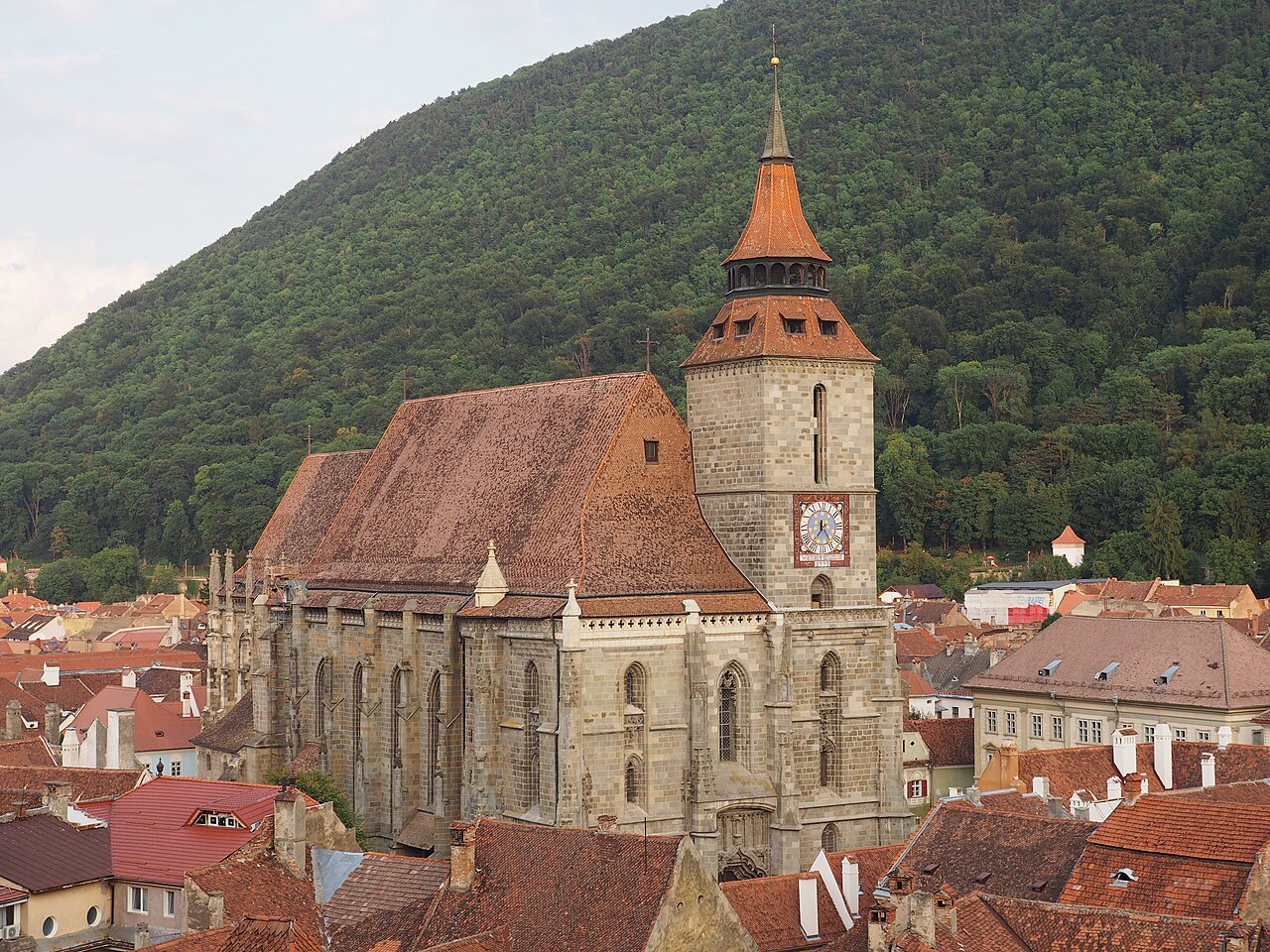
The heart of Brașov is Council Square, a wide cobbled space ringed by pastel Baroque houses, cafés and the old Council House with its clock tower. Behind it rises the dark bulk of the Black Church, the largest Gothic church between Vienna and Istanbul, with a steep roof and a tall tower.
Inside the Black Church are Anatolian carpets hung from the galleries and a huge organ, and concerts are held there in summer. Above the town, Tâmpa Mountain has a cable car and a viewpoint with a big white sign, and the narrow Rope Street is one of Europe’s narrowest streets.
History
Brașov was founded in the thirteenth century by German-speaking Saxon settlers, in the area where the Teutonic Knights had been active, and it became one of the main trading cities of Transylvania, thanks to its position on routes to Wallachia and Moldavia. The Saxon merchants of the town, called Kronstadt in German, built defensive walls and towers, a number of which survive. The Black Church was built from around 1383 to 1477 as a Catholic church and later became Lutheran. Its name comes from the Great Fire of 1689, when the building was badly damaged and its walls blackened by smoke, and it was rebuilt afterwards. In the nineteenth and twentieth centuries the city grew into an industrial centre, and many Saxons left after the Second World War and after 1989. Today it is one of Romania’s most visited cities, a base for the Carpathians and for nearby castles.