Mausoleum of Khoja Ahmed Yasawi (Turkestan)
An unfinished fourteenth-century masterpiece commissioned by Timur, with a huge turquoise dome. UNESCO-listed and a major pilgrimage site.
About
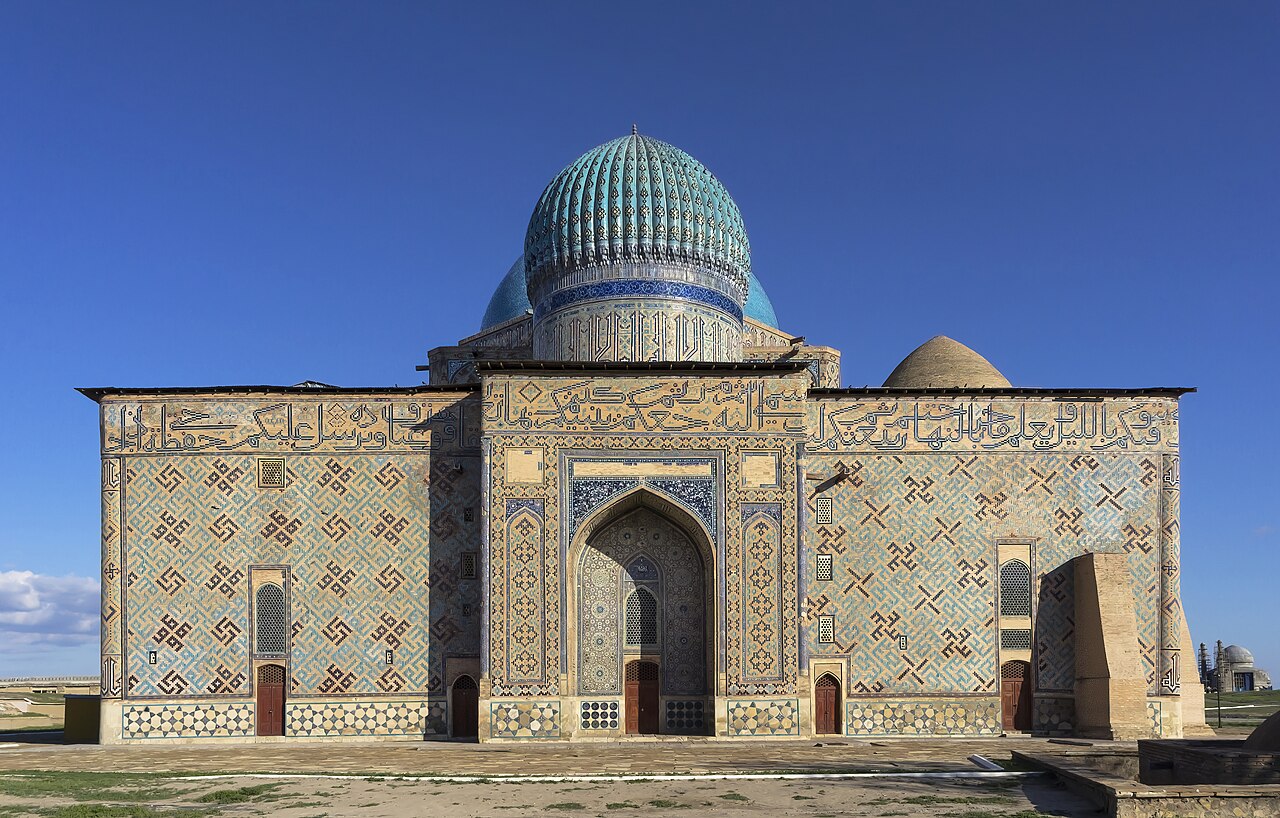
The mausoleum is a massive brick building with a high entrance portal, a row of domes and a great turquoise dome over the central hall. The front is decorated with glazed tiles in blue, white and turquoise, though some areas are left plain.
Inside, the vast central hall holds a giant bronze cauldron, and the tomb of the saint lies in a chamber beneath the dome. Pilgrims come from across Central Asia, and the town of Turkestan around it has been restored with a park and museums.
History
Khoja Ahmed Yasawi was a Sufi poet and teacher who lived in the twelfth century, born in the area of Sayram and died in the town then known as Yasi, now Turkestan, and his teaching and poems were very influential among the Turkic peoples. Around 1389 the Central Asian conqueror Timur, also known as Tamerlane, ordered a grand new mausoleum to be built over his tomb, replacing an earlier smaller shrine. The building was still unfinished when Timur died in 1405, which is why parts of the façade and the interior were never completed, and some of the scaffolding wood still protrudes from the walls. It has the largest brick dome in Central Asia and several features that were tried out here before being used in Samarkand. In the twentieth century it was restored, and in 2003 it became the first site in Kazakhstan to be inscribed by UNESCO. A local belief says that three pilgrimages to the tomb equal one to Mecca, which makes Turkestan a major spiritual centre.
UNESCO World Heritage: Inscribed 2003.