Burana Tower
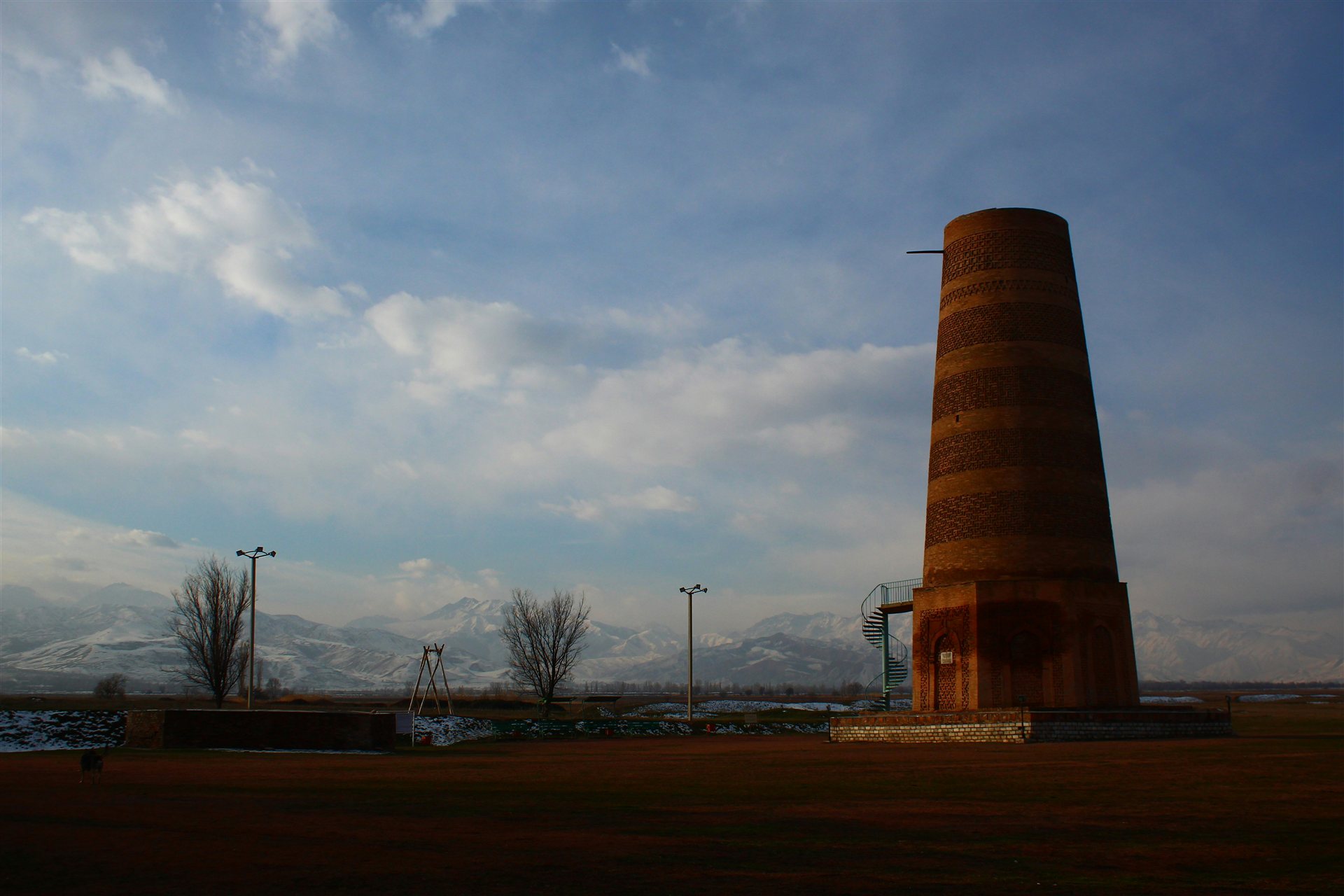
An eleventh-century minaret near Tokmok, all that remains of the Silk Road city of Balasagun. Nearby is a field of ancient stone grave markers called balbals.
About
The Burana Tower is a tall, round brick minaret rising from a grassy plain in the Chuy valley, with a staircase inside that you can climb for views over the steppe and the mountains. It stands in an archaeological park with a small museum.
Around the base, the grounds hold the foundations of a mausoleum and a palace, and a collection of balbals, rough carved stone figures that once marked graves of Turkic warriors, dating from the sixth to tenth centuries. It is an easy day trip from Bishkek.
History
The tower is the surviving part of Balasagun, a city founded in the tenth century that became a capital of the Karakhanid state, which ruled much of Central Asia between the tenth and twelfth centuries. The minaret was built around the eleventh century and originally stood about 45 metres high, among the tallest in the region. An earthquake in the fifteenth century brought down the top, leaving the tower at around 25 metres, and the city itself had been abandoned some time earlier, after being taken by the Kara-Khitans and then hit by the Mongol invasions. In the twentieth century, Soviet archaeologists excavated the site and restored the minaret, rebuilding the missing top section in a simplified way. In 2014 the site was included in the UNESCO World Heritage listing of the Silk Roads: Routes Network of Chang’an-Tianshan Corridor, which links sites across China, Kazakhstan and Kyrgyzstan. The balbals gathered around the tower were brought from the surrounding steppe.
UNESCO World Heritage: Inscribed 2014.