Garni Temple
A first-century Greco-Roman temple on a gorge edge, the only standing pagan temple of its kind in the former Soviet Union.
About
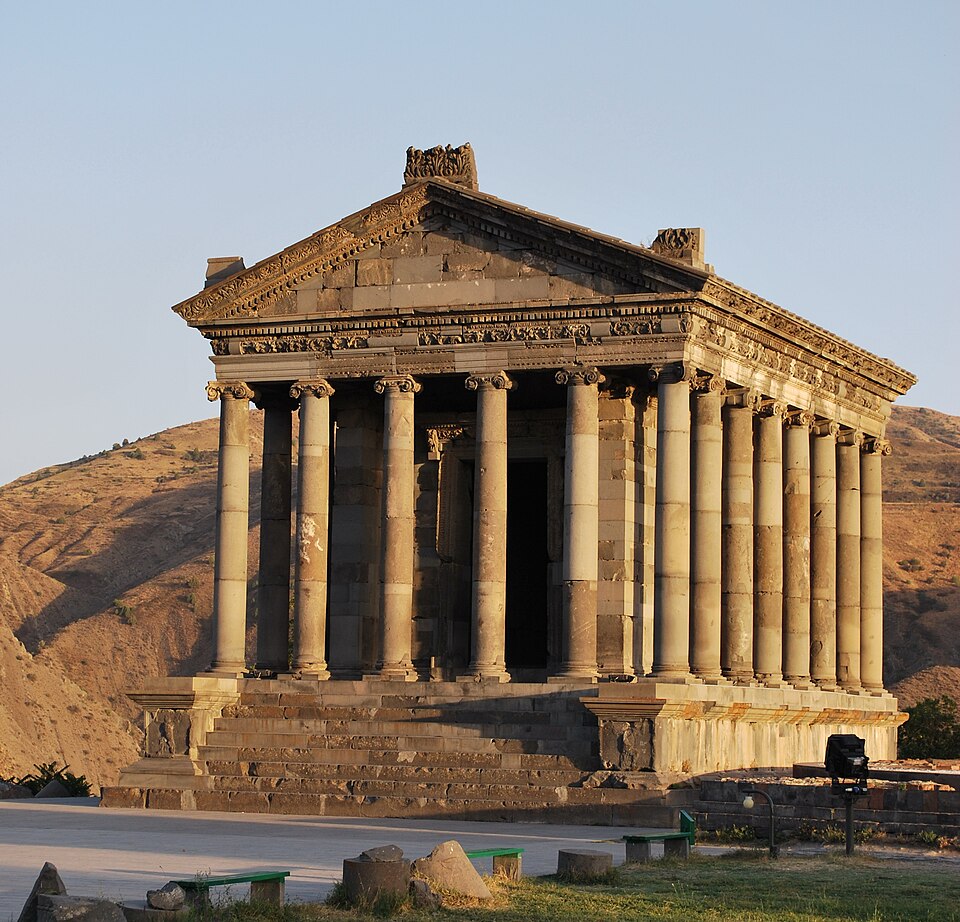
The temple stands on a cliff above the Azat river gorge, a small, elegant building of grey basalt with a colonnade of slim Ionic columns and a decorated frieze. It looks like something from ancient Greece or Rome, in a setting of Armenian hills.
Beside it are the remains of a royal fortress and a Roman-era bathhouse with a mosaic floor. A short trip away, the Symphony of Stones is a canyon wall of tall basalt columns, shaped like organ pipes, best seen from the gorge floor.
History
The temple is thought to have been built in the first century AD, probably under King Tiridates I, as part of a fortified royal summer residence, and was most likely dedicated to the sun god Mihr, the Armenian version of Mithra, though this is still debated. When Armenia adopted Christianity in the early fourth century, pagan temples were closed or destroyed, but Garni may have survived because it was used as a royal summer house. An earthquake in 1679 brought the building down, and its stones lay scattered for almost three centuries. In the 1960s and 1970s Soviet archaeologists and architects rebuilt it from the original blocks, in a process called anastylosis, which is why the temple looks so complete today. The Roman-style baths nearby, with a third-century mosaic of sea creatures and Greek inscriptions, show how strongly the Hellenistic world influenced the kingdom.